Case study
Three days to twenty minutes
ASI's root-cause investigation on field-deployed heavy autonomous vehicles - where downtime costs millions per hour - went from three days to 20 minutes. Gritmind builds AI-powered software that compresses operational work at this scale.
- 3Weeks
- Workshop to productionProof-of-concept running end-to-end three weeks after the on-site workshop.
- 20Minutes
- Root cause foundA past 3-day incident reproduced and resolved in twenty minutes - verified against the original write-up.
- 30Minutes
- By a non-specialistA support engineer pinpointed a vehicle electrical fault in roughly half an hour.
- 1Hour
- vs. seven daysA week-old queued incident resolved during a single one-hour training session.
Why this mattered
A needle in a multi-system haystack
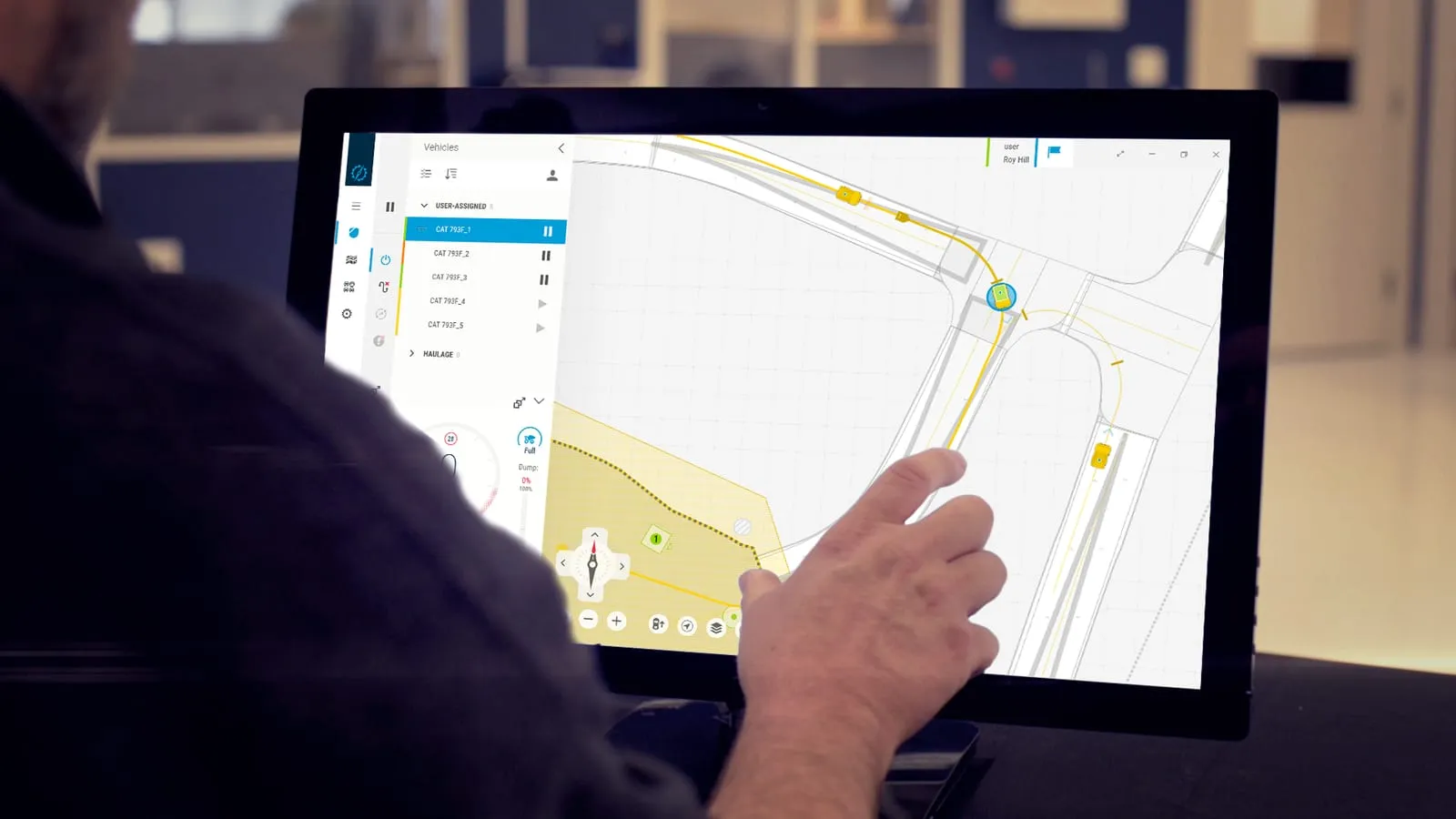
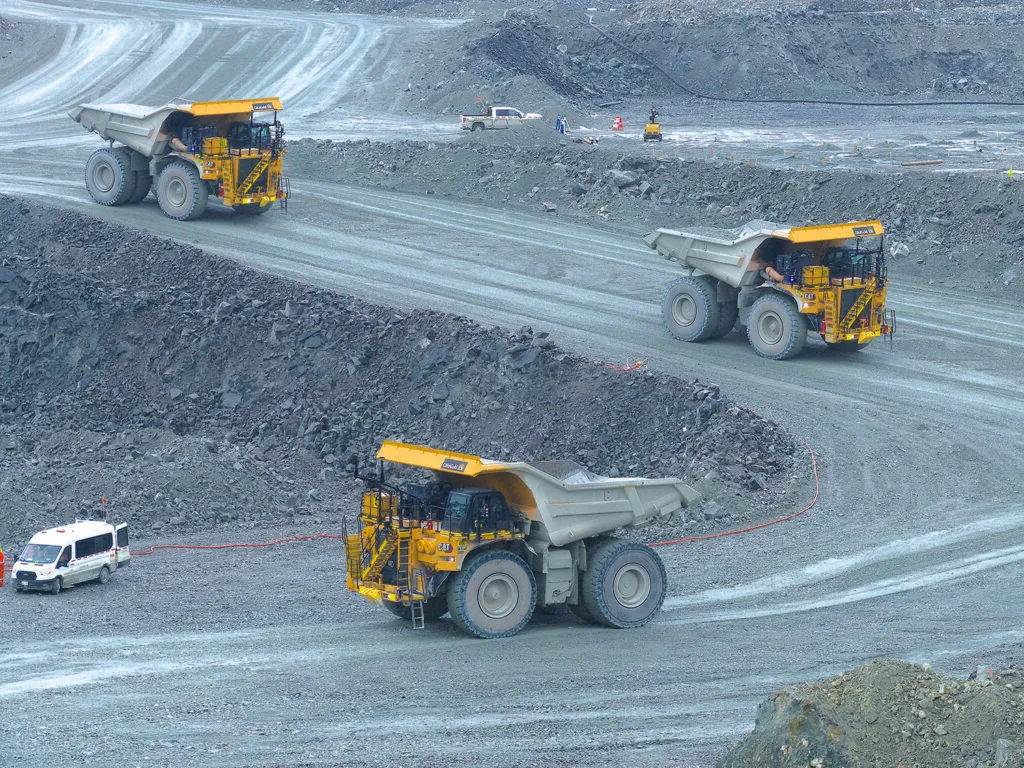
ASI automates machinery for agriculture, logistics, construction and other heavy industrial markets. At the center of their platform is Mobius®, which lets a single operator control a full site of autonomous vehicles from thousands of miles away. That adaptability is a competitive advantage - but it also means that when a vehicle goes down, the investigation spans a complex, multi-subsystem environment.
ASI’s customers operate where downtime is paid for in millions per hour. Each incident generates gigabytes of log data covering minutes of vehicle time, and root-cause determination historically took anywhere from several hours to multiple days of senior engineering effort - with the truck out of service the whole time. Leadership saw a chance to leapfrog: not optimize the steps, but rebuild the workflow AI-first.
' href='data:image/jpeg;base64,/9j/2wBDABALDA4MChAODQ4SERATGCgaGBYWGDEjJR0oOjM9PDkzODdASFxOQERXRTc4UG1RV19iZ2hnPk1xeXBkeFxlZ2P/2wBDARESEhgVGC8aGi9jQjhCY2NjY2NjY2NjY2NjY2NjY2NjY2NjY2NjY2NjY2NjY2NjY2NjY2NjY2NjY2NjY2NjY2P/wAARCAALABQDASIAAhEBAxEB/8QAFwAAAwEAAAAAAAAAAAAAAAAAAAUGB//EACQQAAIBBAECBwAAAAAAAAAAAAECAwAEBRESBiETMUFRgZGh/8QAFQEBAQAAAAAAAAAAAAAAAAAAAgH/xAAaEQADAAMBAAAAAAAAAAAAAAAAARECEhMh/9oADAMBAAIRAxEAPwBT0lPY3l6LXKNtSnGIMSF5b770R6VcHB4V5UhaAFm7hPFfy+6yGJisgIOjTubJXtvZWs0N3MspLbcOeR+arvkElaUQsJGXlFoIS2tkntyOvyipJcrkEUKt5MB7czRQ55C2P//Z'/%3E%3C/svg%3E)
What we built
A multi-agent investigator
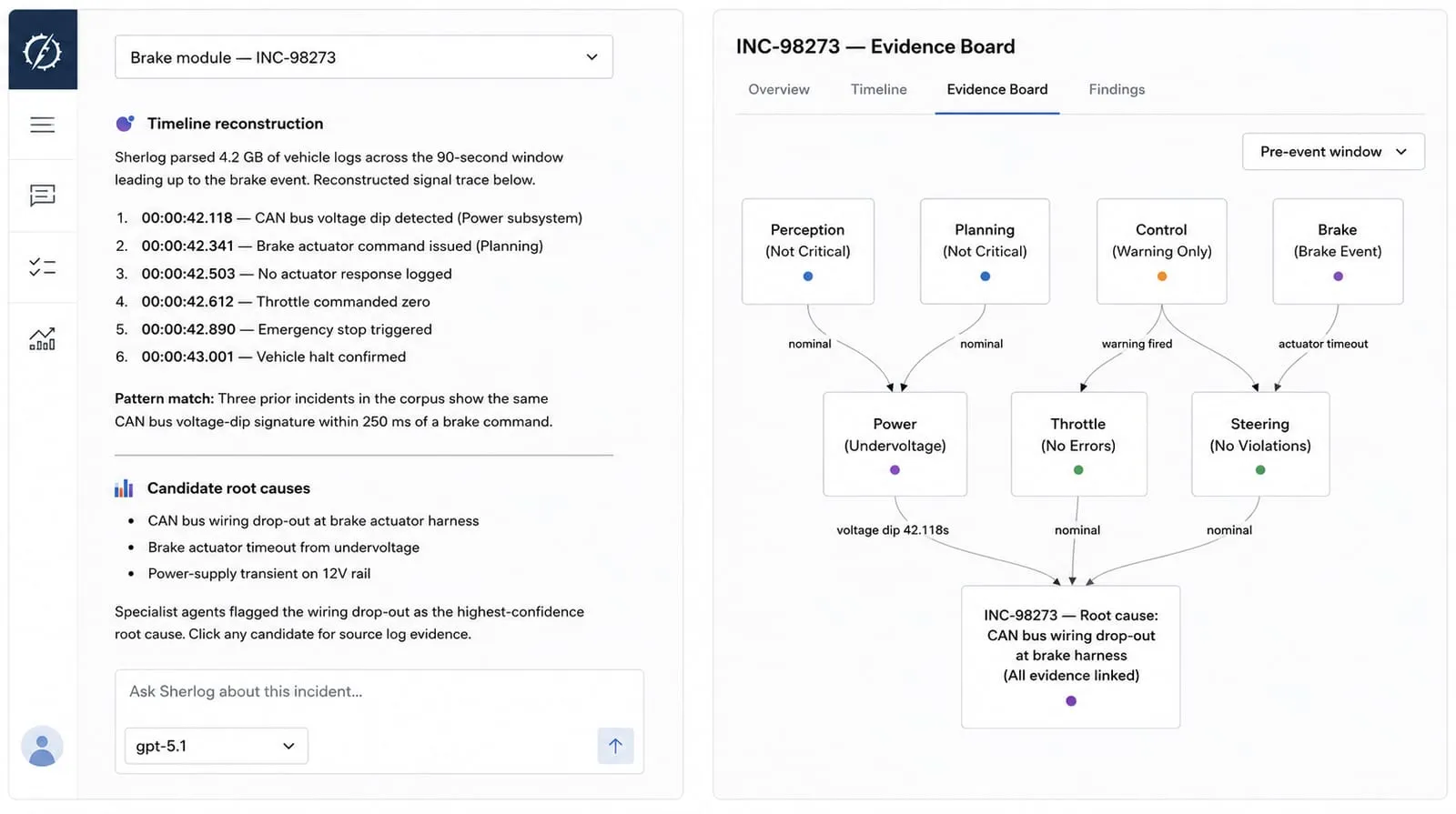
A multi-agent AI system that investigates an autonomous-vehicle incident end to end:
- Parses raw vehicle logs automatically, at gigabyte scale per incident.
- Reconstructs the incident timeline.
- Hands off to specialist sub-agents by domain - brake, throttle, planning and others - to examine their part of the logs and report back.
- Surfaces candidate root causes with click-through evidence to the source log lines.
- Visualizes how events propagate across subsystems - the team’s “evidence-board flowchart.”
- Lets the engineer pin the verified findings. The user owns the final summary, not the model.
' href='data:image/jpeg;base64,/9j/2wBDABALDA4MChAODQ4SERATGCgaGBYWGDEjJR0oOjM9PDkzODdASFxOQERXRTc4UG1RV19iZ2hnPk1xeXBkeFxlZ2P/2wBDARESEhgVGC8aGi9jQjhCY2NjY2NjY2NjY2NjY2NjY2NjY2NjY2NjY2NjY2NjY2NjY2NjY2NjY2NjY2NjY2NjY2P/wAARCAALABQDASIAAhEBAxEB/8QAFwABAQEBAAAAAAAAAAAAAAAAAAEDBv/EABwQAQADAAMBAQAAAAAAAAAAAAEAAhETIUEDEv/EABQBAQAAAAAAAAAAAAAAAAAAAAD/xAAUEQEAAAAAAAAAAAAAAAAAAAAA/9oADAMBAAIRAxEAPwDtqV478fzytK9FTwmqH63O5ag9obKhYxNIA32JYgf/2Q=='/%3E%3C/svg%3E)
How we built it
Three decisions compressed the timeline
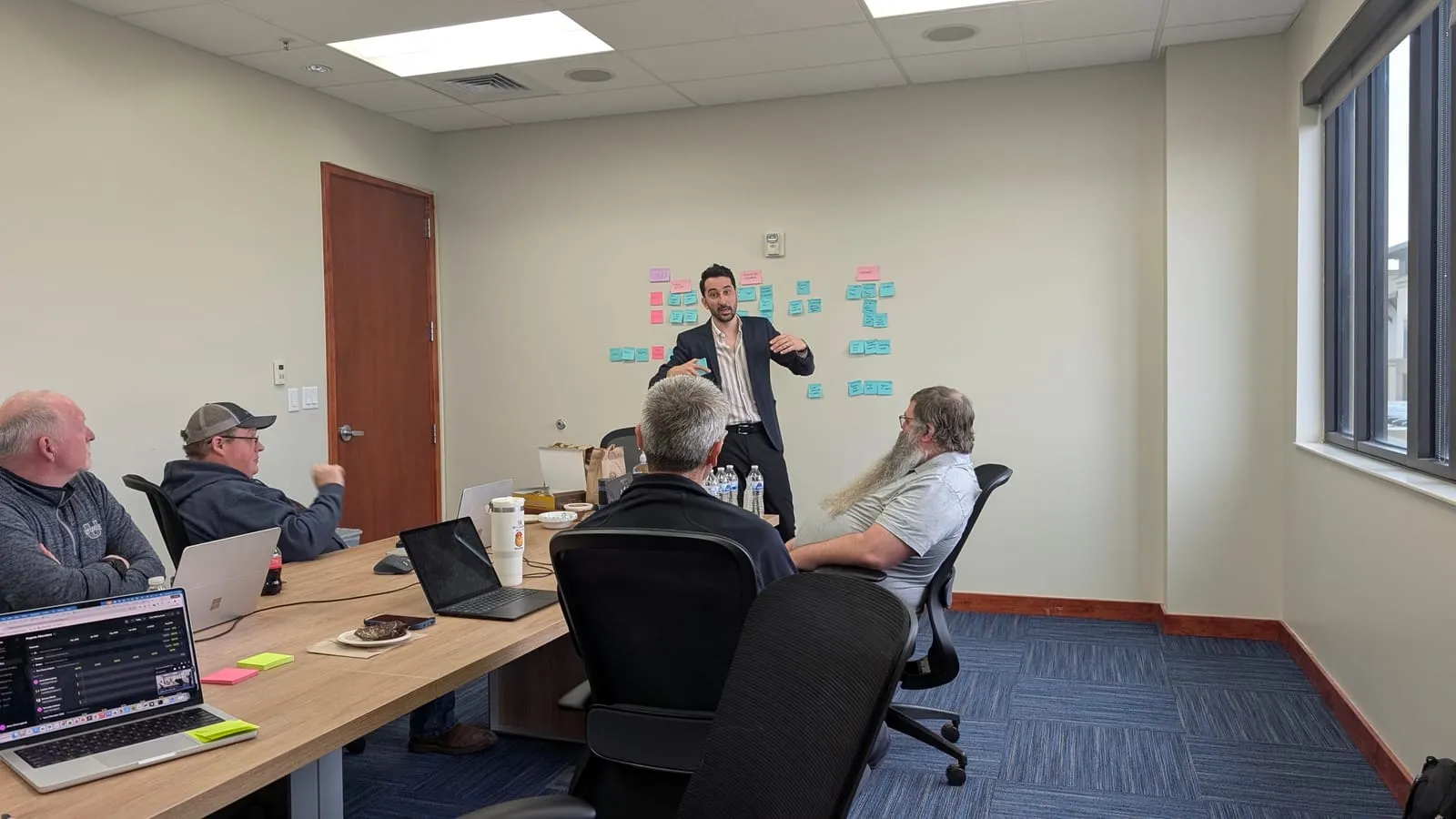
Twenty-five user interviews in three days, on-site
Gritmind ran research at ASI’s site with engineers in every session. Bringing engineering into the interviews - rather than translating findings through documents - meant the team had usable personas and pattern recognition before they left.
Engineers building from observation, not tickets
During the interviews a Gritmind engineer noticed users couldn’t easily see how a failure propagated across subsystems. He turned that observation into the evidence-board flowchart - a feature no PM had requested and no designer had specified.
AI-native from day one
AI showed up on day one, in both the process and the product. The team used it to synthesize research and draft personas in real time, then carried that posture into the build, where a multi-agent architecture became the system - not a layer on top of one.
The decision that made it land
Trust, but verify
Early usability testing surfaced something more interesting than accuracy: calibrated trust. Some engineers were skeptical of the AI’s conclusions; others trusted them too quickly.
So the AI no longer writes the incident summary. It produces a list of candidate problems with supporting evidence, and the engineer pins the ones they’ve verified. The summary belongs to the engineer, not the model. Skeptics get the verification surface they want; optimists are forced to slow down and check.
' href='data:image/jpeg;base64,/9j/2wBDABALDA4MChAODQ4SERATGCgaGBYWGDEjJR0oOjM9PDkzODdASFxOQERXRTc4UG1RV19iZ2hnPk1xeXBkeFxlZ2P/2wBDARESEhgVGC8aGi9jQjhCY2NjY2NjY2NjY2NjY2NjY2NjY2NjY2NjY2NjY2NjY2NjY2NjY2NjY2NjY2NjY2NjY2P/wAARCAALABQDASIAAhEBAxEB/8QAGAAAAwEBAAAAAAAAAAAAAAAAAAMGBAX/xAAiEAACAgIBBAMBAAAAAAAAAAABAgMEABEhBRMxQRQiUYH/xAAVAQEBAAAAAAAAAAAAAAAAAAABAP/EABgRAAMBAQAAAAAAAAAAAAAAAAABEQIh/9oADAMBAAIRAxEAPwB8tuu08HxpSis2nK7XjWxzjKU1K4jtGxZdkD7fnvJ/q8j1KcUNdiiOdsAfP985g6KoPc49YZzR04U1mJhO/ZhDJvg4ZyIrU8QKJIQoPAIBwxrXClP/2Q=='/%3E%3C/svg%3E)
Manual investigation is an incredibly time-intensive process. If you can get to seventy-five percent trust and twenty-five percent verify, you’re already saving millions of dollars in engineering and investigation time.
Outcomes
Pulled, not pushed
Three weeks after the on-site workshop the proof-of-concept was running end to end, and the numbers held across validation cases - a documented three-day incident resolved in twenty minutes, a non-specialist resolving an untouched incident in thirty, and a seven-day backlog item cleared inside a one-hour training session.
The clearest signal wasn’t a metric. Support engineers testing the tool began advocating for it to become the standard for incident analysis - they were pulling it in, not being sold on it.
' href='data:image/jpeg;base64,/9j/2wBDABALDA4MChAODQ4SERATGCgaGBYWGDEjJR0oOjM9PDkzODdASFxOQERXRTc4UG1RV19iZ2hnPk1xeXBkeFxlZ2P/2wBDARESEhgVGC8aGi9jQjhCY2NjY2NjY2NjY2NjY2NjY2NjY2NjY2NjY2NjY2NjY2NjY2NjY2NjY2NjY2NjY2NjY2P/wAARCAAPABQDASIAAhEBAxEB/8QAFgABAQEAAAAAAAAAAAAAAAAAAwAC/8QAIhAAAgIBBAEFAAAAAAAAAAAAAQIDEQAEEiExBRNBQpGx/8QAFQEBAQAAAAAAAAAAAAAAAAAAAQP/xAAVEQEBAAAAAAAAAAAAAAAAAAAAEf/aAAwDAQACEQMRAD8ARPLGSa3YJHtoLtsDJzFy6MspPxF3+4kmhj2mmF+1DrBi03pWZiGC82O/vKpERHZARCKIutxGWbGqirhTlhQ//9k='/%3E%3C/svg%3E)
What's next
Where this goes with ASI
With the system in active use, we’re turning to the next high-value problems: integrating on-vehicle data directly into Mobius so investigations no longer require manual transfer, optimizing the tool’s cost profile to scale across large mixed-OEM fleets, and extending the same AI-native pattern to adjacent workflows where senior engineering time is the bottleneck.
Why it matters for you
Load-bearing, not bolted on
Some workflows absorb AI as a layer. Others only work when AI is load-bearing from day one. Knowing which call is right - technically and economically - is what Gritmind brings to a partnership. ASI had the foresight to skip the middle and ask for the end state. That’s the difference between a company that uses AI and one built to win with it.
Ready to turn insights into impact?
Every bottleneck has a root cause.
Whatever challenge you’re facing, we can help you solve it - together.
Keep reading
Supplier portal for a $100M furniture retailer
Bison Commerce works with over 350 suppliers, merchandises over a million unique SKUs, and transacts more than half a million orders each year. Gritmind built software that optimizes supplier product data, automates product marketing, and wins the buy box on Amazon.
Gritmind · May 5, 2025Read case study →InsightForbes Speaks with Gritmind on the Future of Forward-Deployed Engineering
Forbes collaborated with Gritmind to cover AI labs' growing interest in implementation firms. Here's why the model was never the real bottleneck, and what that means for companies trying to move AI from pilot to production.
Ramūnas Zavistanavičius · Sep 25, 2026Read →